Start With a Better Photo Booth Rental Agreement
Looking for a photo booth rental agreement template you can actually adapt to your business? Start with a framework built around the payments, cancellations, venue issues, equipment problems and event-day surprises photo booth operators really encounter.
GET THE TEMPLATE + CONTRACT GUIDE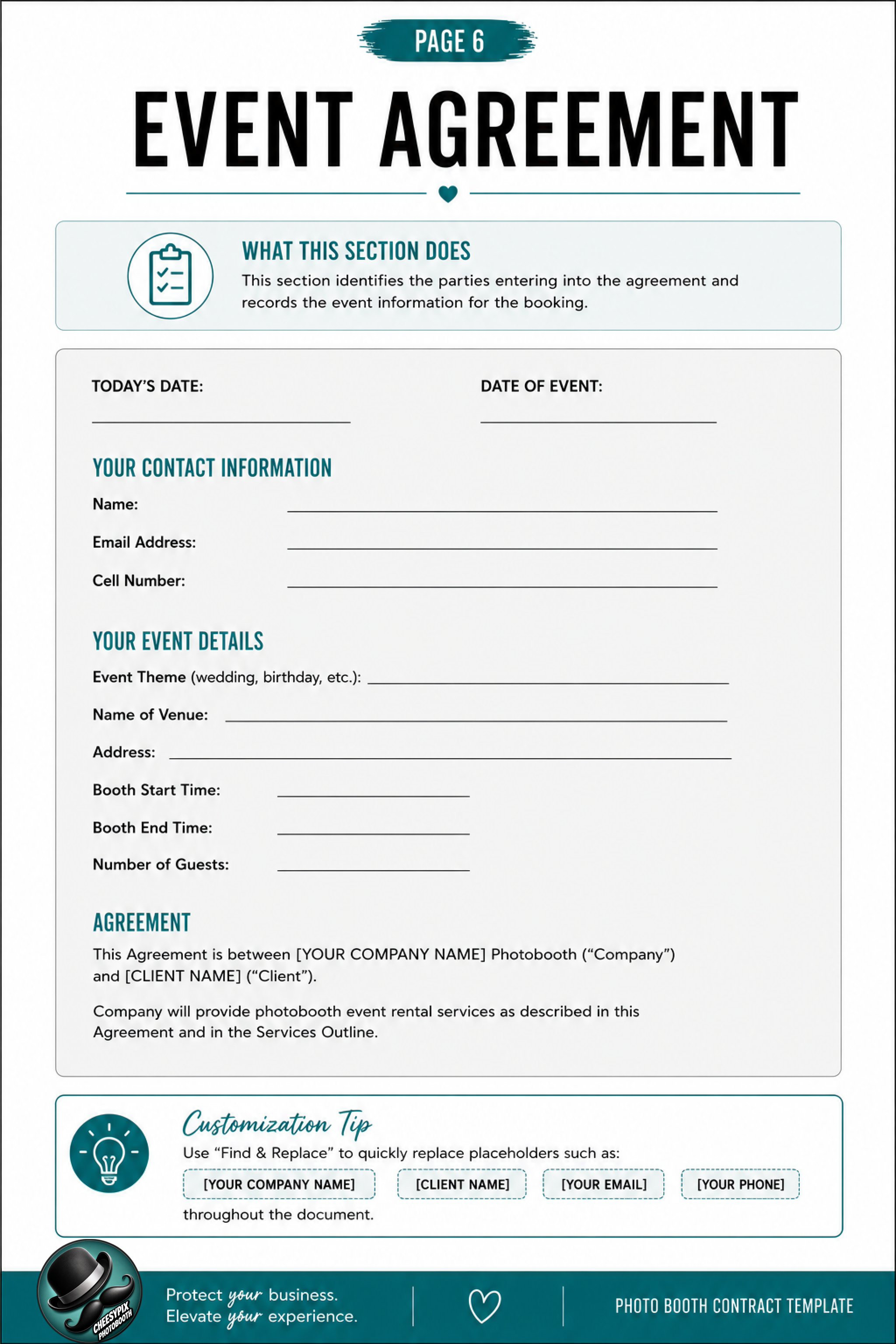
A template should save you time without pretending every photo booth business is identical.
Starting a photo booth agreement from a completely blank page can be surprisingly difficult. You know you need the client's name, event date and price — but then the questions start.
What happens if the event is postponed? Who is responsible for making sure the venue has enough space and power? What if a guest damages the booth? What if the client asks for extra time? How long are you expected to keep an online gallery available?
A useful photo booth rental agreement template gives you a structured place to think through those questions. It should not merely provide a page of generic legal-sounding language.
The best starting point is a framework you understand and can customize to match the way your own business actually operates.
Your agreement has three jobs.
Document the booking
The agreement should clearly identify the event, client, services, operating times, package, pricing and other booking details.
Set expectations
Both parties should understand payment deadlines, venue requirements, setup needs, cancellation rules and responsibilities before event day.
Explain what happens when plans change
A strong agreement helps answer common “what if?” questions before money, equipment or an active event is involved.
What should your photo booth agreement cover?
The exact language will depend on your company and jurisdiction, but a practical agreement framework may address topics like these.
Names, contact information, venue, date, event timing and booking information.
Booth type, operating hours, attendant, prints, backdrop, props, gallery and purchased upgrades.
Total price, booking payment, remaining balance, deadlines and applicable additional charges.
How date changes, cancellations, postponements and prior payments are handled.
Load-in, setup time, elevators, parking, stairs, vendor access and venue restrictions.
Reasonable booth space, electrical power and other technical requirements needed for operation.
Shelter, flooring, temperature, wind, rain and safe operating conditions.
Expectations for sharing features that depend on venue Wi-Fi, cellular service or third-party networks.
Unsafe behavior, interference with equipment and circumstances in which service may need to pause.
Responsibilities related to deliberate or negligent damage caused during the event.
How interruptions, technical problems and circumstances outside the operator's control are addressed.
Whether extra booth time is available, who approves it and what it costs.
Delivery, access, retention periods and client responsibility for downloading files.
Your business policy regarding event images, marketing use and privacy expectations.
Mileage, travel fees, tolls, paid parking or unusual access costs when applicable.
How both parties document agreement to the final terms.
We built ours after actually running the booth.
The CheesyPix Photo Booth Contract Guide grew out of the agreement and real-world situations we encounter while operating an active photo booth business — including venue access, children, Wi-Fi, outdoor conditions, equipment, galleries, delays and other details generic event templates can easily overlook.
SEE THE PHOTO BOOTH CONTRACT GUIDEDon't confuse “free on the internet” with “fits my business.”
A generic contract can still be useful for ideas. The problem starts when you copy language you don't understand or adopt policies that don't match the way you actually operate.
Random generic agreement
- May be written for a completely different rental industry
- May assume services or policies you do not offer
- May ignore booth-specific setup and equipment issues
- May contain legal language you do not understand
- May not reflect the laws where your business operates
Photo booth-specific starting point
- Organized around actual photo booth operations
- Prompts you to think through event-day problems
- Easy to customize around your own packages
- Addresses venue, equipment and gallery details
- Encourages appropriate customization and legal review
Five things to do before using any template.
Replace all company information
Add your legal or business name, contact information and any other identifying details appropriate to your operation.
Match the agreement to your packages
Your contract should describe the booth types, prints, galleries, add-ons and services you actually sell.
Insert your real payment and cancellation policies
Don't inherit someone else's deadlines or refund rules simply because they happened to appear in a template.
Customize the event-day requirements
Adjust space, power, Wi-Fi, outdoor conditions, venue access, staffing and equipment rules to match how your company works.
Review the legal pieces carefully
Contract requirements vary by jurisdiction. Consider having an attorney licensed where you operate review your final agreement, particularly important financial, liability and legal provisions.
You don't need a special platform just to use the agreement.
Once customized, your agreement can be adapted to the booking tools you already use. Photo booth operators may manage contracts through platforms such as HoneyBook or other CRM systems, e-signature tools, online forms, Microsoft Word, Google Docs or similar services.
The important part is not the software. It is having a clear agreement that matches your business and can be consistently presented, accepted and stored with each booking.
Common questions about photo booth agreement templates.
What is a photo booth rental agreement?
A photo booth rental agreement documents the terms between a photo booth company and its client for an event. It commonly identifies the event, services, price, payment terms, operating times and responsibilities, while also addressing issues such as cancellation, venue requirements and equipment.
Is a photo booth rental agreement the same as a photo booth contract?
In everyday business use, the terms are often used interchangeably to describe the written agreement governing a photo booth booking. The legal effect of any particular document depends on its actual contents and applicable law rather than simply what it is called.
Can I edit a photo booth rental agreement template?
Yes — a template is intended to be customized. Update company information, services, pricing, cancellation rules, venue requirements and other terms so the final agreement describes your actual business.
Should my rental agreement include overtime?
If clients sometimes request additional booth time, having a written overtime policy can clarify whether extra time is available, how it is approved and what rate applies.
Should my agreement include Wi-Fi requirements?
If texting, email sharing, cloud galleries or other features depend on internet connectivity, explaining those requirements and limitations can prevent confusion when venue Wi-Fi or cellular service is unreliable.
Do I need an attorney to review my photo booth agreement?
A template or educational guide is not legal advice. Because laws and contract requirements vary by state and jurisdiction, having an attorney licensed in the appropriate jurisdiction review your final agreement can be worthwhile.
Building your agreement? Start here.
Skip the blank page.
Get our 19-page Photo Booth Contract Guide with explanations, real-world photo booth considerations and a customizable rental agreement framework you can adapt for your own business.
GET THE TEMPLATE + GUIDEImportant: This page and the CheesyPix Photo Booth Contract Guide are provided for educational and informational purposes only and are not legal advice. Contract laws and requirements vary by state, jurisdiction and business. Customize any template for your circumstances and consider having your final agreement reviewed by a licensed attorney before using it with clients.